Showing posts with label hydrostatic. Show all posts

Tuesday, 13 February 2018

Fluid Statics

Pascal's Law

In the absence of shearing stress, pressure at any point in fluid in independent of direction.
Px = Py = Pz


BASIC EQUATION FOR THE PRESSURE FIELD
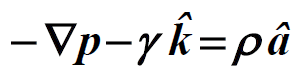
AT Rest,

For incompressible Fluid,


Absolute Pressure

Pressure measured with reference to absolute zero. 


  • Absolute pressure can not be zero.
  • Gauge pressure can be positive or negative.
  • At mean sea level atmospheric pressure is 1.01x10^5 Pa or 1 Bar.

Hydrostatic Force on a plane Surface

The force must be perpendicular to the surface since there are no shearing stresses present when fluid is at rest. The pressure will vary linearly with the depth if the fluid is incompressible.


  • Magnitude of FR is independent of angle θ.
  • FR is perpendicular to the surface.
  • Location of resultant force :


Hydrostatic force for Curved surface

  • Horizontal Force (FH) : This can be computed by projecting the surface upon a vertical plane and multiplying the projected area by the pressure at its own center of area.
  • Vertical Force (Fv) : It is equal to the weight of the liquid block lying above the curved surface upto the free surface.


Buoyancy And Flotation

Archimedes Principle

When a body is completely submerged in a fluid, or floating so that it is only partially submerged, then the resultant upward force acting on the body is called BUOYANCY FORCE which is equal to the weight of liquid displaced by the body.

The line of action of the buoyant force passes through the centroid of the displaced volume. The centroid is called the Center of buoyancy.

Archimedes Second Principle


A floating body displaces a volume of fluid equivalent to its own weight.
A body will float if its average density is less than the density of the fluid in which it is placed


Condition for Equilibrium for Floating Body


Metacentre : is defined as the point about which body starts oscillating when body is titled by small angle. 
It can also be defined as the point at which the line of action of buoyancy force will meet the normal axis to the body when body is titled by small angle. 

  • A floating body will be in Stable Equilibrium if M is above G or GM is positive.
  • Unstable Equilibrium if M is below G or GM is negative. 
  • Neutral Equilibrium if M = G.

Time Period of Oscillation


If a floating body oscillates the is time period is given by


Where, 
k = Least radius of gyration
h = meta-centric height (GM)
g = gravity

Contact Form

Name

Email *

Message *