Showing posts with label Radiation. Show all posts

Sunday, 20 May 2018

Radiation-II


THE VIEW FACTOR/SHAPE FACTOR


It is a purely geometric quantity and is independent of the surface properties and temperature. It is also known as configuration factor and angle factor.

The view factor from a surface i to a surface j is denoted by Fi → j or just $F_{ij}$, and is defined as
$F_{ij}$ = the fraction of the radiation leaving surface i that strikes surface j directly
\[F_{ij} = \frac{Q_{ij}}{Q_i}\]
Here,            $Q_{ij}$ =  fraction of rate of energy leaving surface i reaching surface j
                    Qi = Rate of total energy radiated by surface i

  • In general, 0 ≤ $F_{ij}$ ≤ 1.
  • The view factor from a surface to itself is zero for plane or convex surfaces and nonzero for concave surfaces.


Reciprocity Relation

\[\boxed{A_1F_{12} = A_2F_{21}}\]

Summation Rule

The sum of the view factors from surface i of an enclosure to all surfaces of the enclosure, including to itself, must equal unity.
\[\boxed{\sum^N_{j =1} F_{ij}  =1}\]

$F_{11} = 0$

$F{11} + F_{12} = 1$   (Summation Rule)

hence $F_{12} = 1$

$A_1F{12} = A_2F_{21}$   (Reciprocity Rule)

$F_{21} = \frac{A_1}{A_2}$

$F_{21} + F_{22} = 1$   (Summation Rule)  

$F_{22} = 1 - F_{21} = 1 - \frac{A_1}{A_2}$


Superposition Rule


The view factor from a surface i to a surface j is equal to the sum of the view factors from surface i to the parts of surface j. 

Note : The reverse of this is not true.

 \[F_{1(23)} = F_{12} + F_{13}\]
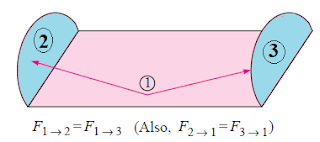


Symmetry Rule


This Rule can be expressed as two (or more) surfaces that possess symmetry about a third surface will have identical view factors from that surface.


The Crossed-Strings Method


View Factors between Infinitely Long Surfaces is given by
\[F_{12} = \frac{(L_5 +L_6) -(L_3 + L_4)}{2*L_1}\]

\[F_{ij} = \frac{\sum (Crossed \quad Strings) - \sum (Uncrossed \quad Strings)}{2*(String \quad on \quad surface 'i')}\]


Net Radiation Heat Transfer to or from a Surface


Net Energy Leaving a Surface

The net energy leaving from the surface will be equal to the difference between the energy leaving a surface and the energy received by a surface 
\[Q_i = A_i(J_i -G_i)\]
\[J = ε E_b + ρG\]
If Surface is opaque, ρ = 1 – α 

J = ε Eb + (1 – α) G


we get,   $Q_i = \frac{E_b - J_i}{R_i}$ and $R_i = \frac{1-ε_i}{A_iε_i}$ is the surface resistance to the radiation.

Net Exchange Between Surfaces


The net rate of radiation heat transfer from surface i to surface j can be expressed as
\[Q_{ij} = A_iJ_iF_{ij} - A_jJ_jF_{ji}\]
\[Q_{ij} = \frac{J_i - J_j}{R_{ij}}\]
where $R_{ij}= \frac{1}{A_iF_{ij}}$ is the space resistance to the radiation.

Electrical circuit representation of two surfaces which can see each other nothing else


Total resistance      $R_t = \frac{1-ε_1}{ε_1A_1} + \frac{1}{A_1F_{12}} + \frac{1-ε_2}{ε_2A_2}$
\[Q_{12} = \frac{E_{b1} - E_{b2}}{R_t}\]

Radiation Shields

Assume two flat infinite long flate surfaces 1 and 2 have N shields in between.


Net Heat Transfer without any shield:
\[Q = \frac{A \sigma (T_1^4 - T_2^4)}{\frac{1}{ε_1} + \frac{1}{ε_2} -1}\]

Net Heat transfer with N shields
\[Q = \frac{A \sigma (T_1^4 - T_2^4)}{(\frac{1}{ε_1} + \frac{1}{ε_2} -1) + \sum^N_{j=1}(\frac{1}{ε_{j,1}} + \frac{1}{ε_{j,2}} -1) }\]


***
If you have any query, ask in comments.

Saturday, 19 May 2018

Radiation


Radiation is the mode of heat transfer across a system boundary due to a temperature difference in the form of electromagnetic waves as a result of change in the electronic configurations of the atoms and molecules. Radiative heat transfer does not require a medium to pass through; thus, it is the only form of heat transfer present in vacuum.

Electromagnetic Spectrum


All types of electromagnetic waves are classified in terms of wavelength and are propagated at the speed of light (c = 3 x 10^8 m/s).

Electromagnetic Spectrum


Stefan-Boltzman Law


The emissive power of a black body is proportional to absolute temperature to the fourth power.
\[ \boxed{E_b = σ T^4}\]
where:          Eb = Emissive Power, the gross energy emitted from an ideal surface per unit area, time 
  σ = Stefan Boltzman constant, $5.67X10^{-8} W/m^2 K^4$
T = Absolute temperature of the emitting surface, K.

Plank’s Law

\[E_{bλ} = \frac{C_1}{λ^5(e^{\frac{C_2}{λT}}-1)}\]
$C_1 = 2 \pi h c^2 = 3.742 × 10^8 Wμm^4 / m2 $
$C_2 = h c/k = 1.439 × 10^4 μm-K $

$E_{bλ}$ = Monochromatic (single wavelength)  Emissive Power of a black body
c = speed of light = 3x 10^8 m/s
h = Plank's constant = 6.625 x 10^-34 J-s
λ = Wavelength, μm
k = Boltzmann constant = 1.3805 x 10^-23 J/K
T = Absolute temperature, K

An implicit definition Monochromatic (single wavelength) Emissive Power, $E_{bλ}$  is given by
\[E_b = \int^∞_0 E_{bλ}. dλ\]  


  • We can obtain Stefan-Boltzmann Law by integrating Plank's law over all wavelengths.

Wien Displacement Law


It state that the product of the temperature(T) of a black body and the wavelength(λm) at which the maximum value of monochromatic emissive power occurs, is constant.

\[λ_m T = Constant = 2897  μm.K\]


Some Definitions


Black Body

A black body is defined as a perfect emitter and absorber of radiation. It absorbs all incident radiation regardless of wavelength and direction.

Diffuse Surface

A surface is said to be diffuse if its properties are independent of direction.

Gray Surface

A surface is said to be gray if its properties are independent of wavelength.

Radiation Intensity (I)

It is defined as the energy emitted from an ideal body, per unit projected area on a plane normal to the direction of radiation, per unit time, per unit solid angle. 
\[I = \frac{dq}{dA cos θ d \Omega}\]

Emissivity (ε)

Real surfaces have emissive power, E somewhat less than that of ideal surface (black body). It is defined as the ratio of Emissive power of any body to the Emissive power of a black body of equal temperature.
\[ε = \frac{E}{E_b}\]
Note:
  • For a black body ε = 1, for white body ε = 0.
  • Value of ε varies from 0 to 1.
  • Emissivity may vary with temperature and wavelength.

Receiving Properties


Irradiation(G)

Total incident radiation on a surface from all directions per unit time and per unit area of surface.

  1. The fraction of irradiation absorbed by the surface is called the absorptivity(α),
  2. the fraction reflected by the surface is called the reflectivity (ρ), and
  3. the fraction transmitted is called the transmissivity (τ). For opaque body τ =0.
\[G_{abs} + G_{ref} + G_{tr} = G\]
\[\boxed{α + ρ + τ = 1}\]

Radiosity (J)

It is defined as the radiation energy leaving from a surface per unit time, per unit area of surface. 
\[J = E +  ρG\]

Note:  For a black body J = Eb, since it absorbs all incident radiation and hence no reflection.

Kirchhoff's Law

The emissivity of a body is equal to its absorptivity whenever body is in thermal equilibrium with its surroundings. We can say a good absorber is a good emitter.
\[\boxed{ α = ε}\]

Intensity of Radiation and Lambert's Cosine Law

According to Lambert's Cosine Law, the radiant intensity observed from an ideal ideal diffuse surface is directly proportional to the cosine of the angle of emission (θ).
\[I = I_n cos(θ)\]

  • Emissive power of a black body is $\pi$ times the intensity of radiation.
\[E_b = \pi I_b\]


Contact Form

Name

Email *

Message *