THE VIEW FACTOR/SHAPE FACTOR
It is a purely geometric quantity and is independent of the surface properties and temperature. It is also known as configuration factor and angle factor.
The view factor from a surface i to a surface j is denoted by Fi → j or just $F_{ij}$, and is defined as
$F_{ij}$ = the fraction of the radiation leaving surface i that strikes surface j directly
\[F_{ij} = \frac{Q_{ij}}{Q_i}\]
Here, $Q_{ij}$ = fraction of rate of energy leaving surface i reaching surface j
Qi = Rate of total energy radiated by surface i
- In general, 0 ≤ $F_{ij}$ ≤ 1.
- The view factor from a surface to itself is zero for plane or convex surfaces and nonzero for concave surfaces.

Reciprocity Relation
\[\boxed{A_1F_{12} = A_2F_{21}}\]
Summation Rule
The sum of the view factors from surface i of an enclosure to all surfaces of the enclosure, including to itself, must equal unity.
\[\boxed{\sum^N_{j =1} F_{ij} =1}\]

$F_{11} = 0$
$F{11} + F_{12} = 1$ (Summation Rule)
hence $F_{12} = 1$
$A_1F{12} = A_2F_{21}$ (Reciprocity Rule)
$F_{21} = \frac{A_1}{A_2}$
$F_{21} + F_{22} = 1$ (Summation Rule)
$F_{22} = 1 - F_{21} = 1 - \frac{A_1}{A_2}$
Superposition Rule

The view factor from a surface i to a surface j is equal to the sum of the view factors from surface i to the parts of surface j.
Note : The reverse of this is not true.
\[F_{1(23)} = F_{12} + F_{13}\]
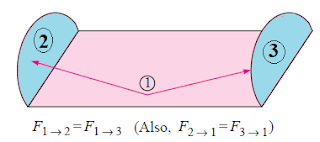 Symmetry Rule

This Rule can be expressed as two (or more) surfaces that possess symmetry about a third surface will have identical view factors from that surface.
The Crossed-Strings Method

View Factors between Infinitely Long Surfaces is given by
\[F_{12} = \frac{(L_5 +L_6) -(L_3 + L_4)}{2*L_1}\]
\[F_{ij} = \frac{\sum (Crossed \quad Strings) - \sum (Uncrossed \quad Strings)}{2*(String \quad on \quad surface 'i')}\]
\[F_{ij} = \frac{\sum (Crossed \quad Strings) - \sum (Uncrossed \quad Strings)}{2*(String \quad on \quad surface 'i')}\]
Net Radiation Heat Transfer to or from a Surface
Net Energy Leaving a Surface
 The net energy leaving from the surface will be equal to the difference between the energy leaving a surface and the energy received by a surface
\[Q_i = A_i(J_i -G_i)\]
\[J = ε E_b + ρG\]
If Surface is opaque, ρ = 1 – α
J = ε Eb + (1 – α) G
we get, $Q_i = \frac{E_b - J_i}{R_i}$ and $R_i = \frac{1-ε_i}{A_iε_i}$ is the surface resistance to the radiation.
Net Exchange Between Surfaces
The net rate of radiation heat transfer from surface i to surface j can be expressed as
\[Q_{ij} = A_iJ_iF_{ij} - A_jJ_jF_{ji}\]
\[Q_{ij} = \frac{J_i - J_j}{R_{ij}}\]
where $R_{ij}= \frac{1}{A_iF_{ij}}$ is the space resistance to the radiation.
Electrical circuit representation of two surfaces which can see each other nothing else

Total resistance $R_t = \frac{1-ε_1}{ε_1A_1} + \frac{1}{A_1F_{12}} + \frac{1-ε_2}{ε_2A_2}$
\[Q_{12} = \frac{E_{b1} - E_{b2}}{R_t}\]
\[Q_{12} = \frac{E_{b1} - E_{b2}}{R_t}\]
Radiation Shields
Assume two flat infinite long flate surfaces 1 and 2 have N shields in between.

Net Heat Transfer without any shield:
\[Q = \frac{A \sigma (T_1^4 - T_2^4)}{\frac{1}{ε_1} + \frac{1}{ε_2} -1}\]
Net Heat transfer with N shields
\[Q = \frac{A \sigma (T_1^4 - T_2^4)}{(\frac{1}{ε_1} + \frac{1}{ε_2} -1) + \sum^N_{j=1}(\frac{1}{ε_{j,1}} + \frac{1}{ε_{j,2}} -1) }\]
***
If you have any query, ask in comments.
I just want to thank you for sharing your information and your site or blog this is simple but nice Information I’ve ever seen i like it i learn something today. Timeless Jewelry Pieces
ReplyDeleteGreat breakdown of the view factor! It’s crazy how much geometric orientation impacts radiation heat transfer. As an fr4 pcb assembly company, managing thermal design is everything for us. This shape factor math is spot on for preventing board overheating. Stacking components right makes all the difference! Excellent, practical read.
ReplyDelete